How Old Does a Whale Shark Need to Be Before It Can Reproduce?
C overed in polka dots and stretching the length of a single-decker bus, the gentle giant barrelled towards them. The team of scientists, ready with a 17kg waterproof ultrasound machine they had lugged to ane of the earth's most isolated dives sites, waited for the whale shark.
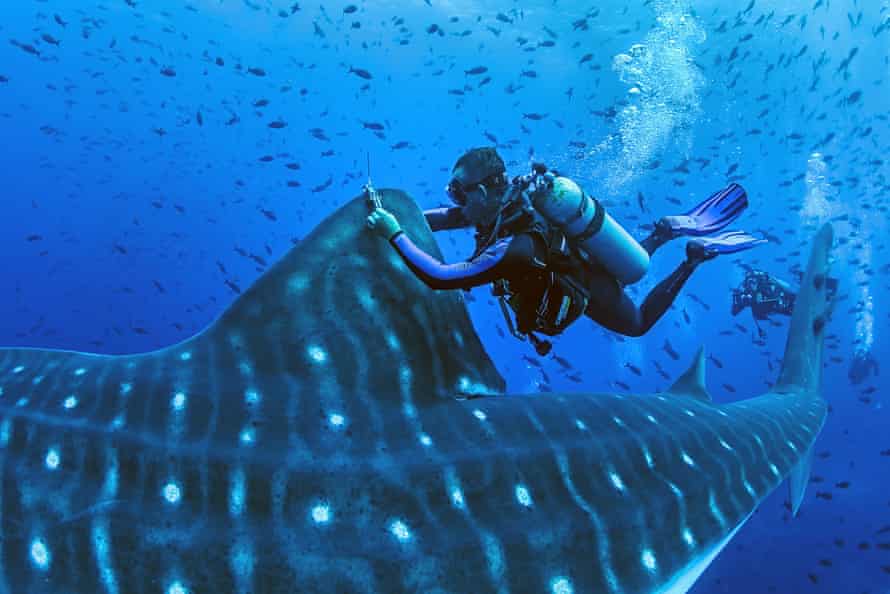
Months of preparation had gone into the encounter, expected to last between 30 and 45 seconds. Aided into position past a propeller mounted on his air tank, one scientist glided underneath the hulking fauna as information technology swam by, raking a handheld probe across her distended belly – yielding the earth's first ultrasound of a wild whale shark.
The ultrasounds, carried out in 2022 on iii females off the Galápagos Islands, were aimed at teasing autonomously one of the ocean's greatest mysteries: decades later on inquiry began in hostage on whale sharks, scientists accept few clues as to how they mate or where they requite birth.
01:25
"Here is the biggest fish in the oceans, it'due south almost certainly the biggest shark," says Jonathan R Green, the managing director of the Galapagos Whale Shark Project. "And what is known nearly their reproductive behaviour is about goose egg."
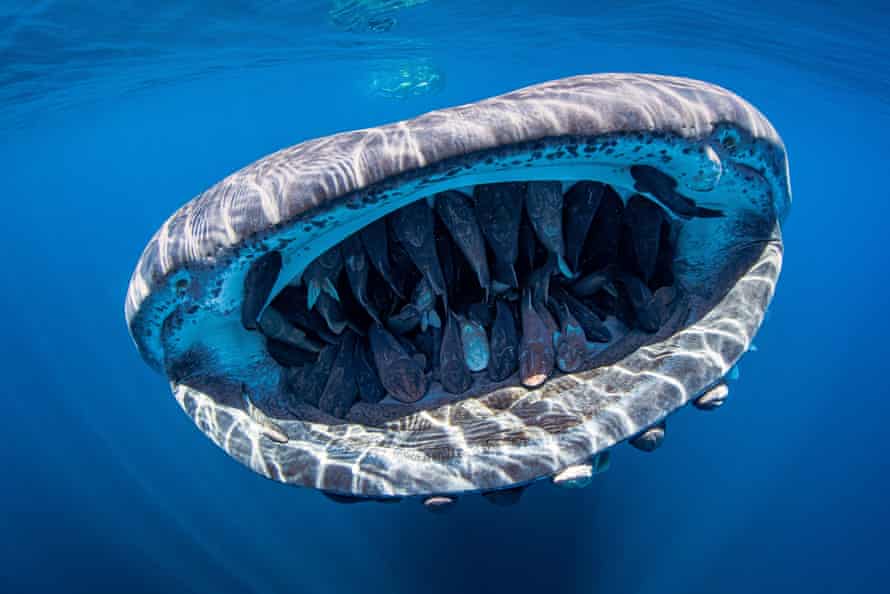
For more than 70m years, some class of the whale shark has roamed the oceans, their existence overlapping with the Tyrannosaurus rex at one point. A docile filter-feeder, the whale shark challenges the stereotype of sharks as giant, toothy predators. Its 300 of rows of teeth are microscopic, it moves through the water at a relatively plodding pace and has been known to allow phalanxes of other fish to hitch a ride.
Still, whale sharks have proven to be just equally headline-grabbing as their fearsome relatives. Researchers in Japan recently discovered that they have retractable eyes, with the center surface around the iris covered in nearly 3,000 tiny tooth-like structures known every bit "dermal denticles", while another research team documented thousands of shrimp-like creatures living in the mouth of ane whale shark.
"There are few things today on our planet that you tin say, 'that is absolutely new to scientific discipline, we didn't know that earlier'," says Green. "So it'south a fleck like the discovery of gravity – information technology's an exciting field to work in, but it can exist frustrating too."
Q&A What is the truth nigh sharks serial?
Bear witness
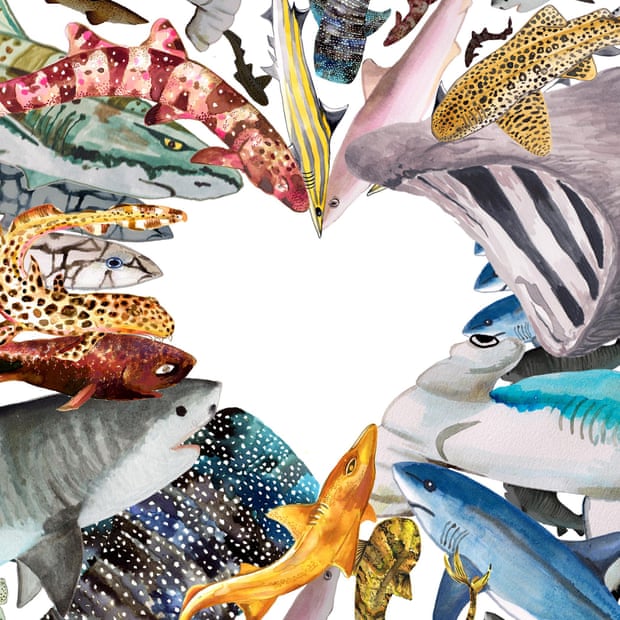
Mysterious and often misunderstood, the shark family is magically diverse – from glowing sharks to walking sharks to the whale shark, the ocean'south largest fish. Only these magnificent animals very rarely threaten humans: so why did dolphins get Flipper while sharks got Jaws?
Sharks are increasingly considered, like whales, to play a crucial office in bounding main ecosystems, keeping entire food chains in balance – and have done so for millions of years. But these apex predators are now in grave danger. The threats they face up include finning ( in which their fins are sliced off before they are thrown dorsum into the water), warming seas, and being killed every bit bycatch in huge fishing operations.
To gloat our emerging understanding of sharks' truthful nature and investigate the many underreported ways in which humans rely on them, the Guardian is devoting a week to rethinking humanity's relationship with the shark – considering if they are to survive, these predators cannot exist prey for much longer.
Photograph: Good Wives and Warriors
Dark-green and his team carried out the ultrasounds after noticing that the whale sharks that assemble off the Galápagos were nearly all females with bloated bellies, in dissimilarity to the large gatherings of generally juvenile males in coastal regions around the world.
While the ultrasounds didn't confirm the whale sharks were meaning, they did reveal ovaries and what appeared to be unfertilised eggs, hinting that more than research is needed to untangle the significance of the area to whale shark reproduction.
Green and his team as well tagged several of the animals, only to discover out that they often dive beyond the 2,000-metre range of the tags. He and his team take been at pains to explain this "spiralling behaviour", as the deep water dives seemingly confer footling advantage in escaping predators, birthing pups or finding the plankton that whale sharks mostly feed on.
"So information technology's layer upon layer of mystery that we're trying to peel our way through," says Light-green. "And every time we come up up with some kind of significant data, it but begs a whole series of new questions."
These questions have taken on new urgency in recent years. "Every solar day there are fewer of them," says Greenish. "We're losing these animals at a rate which is unprecedented in the history of planet Earth, perhaps with the exception of the Cretaceous-Third Thousand-T mass extinction, when the dinosaurs were wiped out."
Whale sharks were listed equally endangered in 2016, their survival imperilled past fisheries, where they turn upwardly as by-catch, and the need for shark fins in Asia – with a single pectoral fin able to internet every bit much as $20,000 (£16,000).
The search for answers, notwithstanding, has in part been stymied past the technical challenges of tracking an animate being that ranks among the ocean's nigh widely travelled, shifting betwixt open ocean, littoral areas and the deep sea. A 2022 written report on a whale shark named Anne saw her travel more than 12,500 miles across the Pacific over the bridge of two years and 3 months, at one signal making her fashion to the Mariana Trench – the deepest place on Earth.
The glaring gaps in our noesis about the earth's biggest fish, yet, also reflect our priorities every bit a gild, says Greenish. "Nosotros've literally shown more interest in exploring outer space than nosotros take the depths of our oceans."
Scientists are at present locked in a race against time. "How tin can you take an informed conservation programme for an animate being if you lot don't know how, when or where it breeds?" asked Alistair Pigeon, the vice-president of research and conservation at the Georgia Aquarium in Atlanta, The states. The aquarium is home to 4 juvenile whale sharks that accept notwithstanding to reach sexual maturity.
In the wild, once whale sharks are born, little is known about the first years of their lives, he says. "At that place's a sort of lost years menses, between when they're born at about 45–60cm long, until they're up to about 3–four metres long. That period in between at that place, we don't know where they are."
Tantalising clues have turned up effectually the globe. A significant female harpooned past a commercial fishing vessel in Taiwan in 1995 was constitute to be carrying more than 300 pups in different stages of development. Analyses carried out years later immune researchers to determine that 29 pups still remaining from the litter all had the same father, suggesting whale sharks mate once, store the sperm and fertilise their own eggs as needed, says Jennifer Schmidt, the manager of science and enquiry for the Shark Research Found.
A 2022 video, shot past a pilot flight over the Ningaloo reef in Western Australia, showed an adult male whale shark swimming erratically, zigzagging through the water as it seemingly vied for the attending of a nearby female. Then it flipped upside down, underneath the female, brandishing his two claspers – the name given to the male's penis-like organs. While some celebrated the video equally a mating act caught on camera, information technology's articulate that the female was too young to breed, says Schmidt.
"You've got a juvenile with an developed – it could be some sort of mating play behaviour, some sort of practice, only it's not a bona fide mating event because one of the sharks is not quondam enough to exist reproductive," she added.
Over the years, two eyewitness reports of mating take been documented, both of them from the far-flung island of St Helena in the southward Atlantic. Unaware of each other's reports, two men described the aforementioned ritual: splashing that gave way to the male and female in vertical positions – abdomen to belly – before the female ended upwards on summit and the male person slipped underneath her.
The reports were bolstered by the fact that the waters off the volcanic island are one of the few places in the world where developed male and female whale sharks take been spotted in equal numbers.
"I have no doubt they both saw whale shark mating," says Dove of the Georgia Aquarium, who travelled to St Helena after hearing of the reports. "Nosotros merely don't have that thing that everybody expects in the 21st century, which is if you didn't become it on video, it didn't happen."
In the absenteeism of hard prove, he and other scientists are pushing forrard, determined to uncover the secrets that have surrounded whale sharks for millions of years. "The ocean holds on to her secrets pretty tightly," says Dove.
"It'south frustrating to me, as a marine biologist, that nosotros can have this enormous animal and know and so little about it," he adds. "The whale shark is now endangered. And we can't expect to pull it back from that situation if we don't empathize how that life history works."Share your thoughts and experiences using the hashtag #sharklife on Twitter and Instagram, and follow our shark series at Guardian Seascape: the state of our oceans
manningweenctiny1987.blogspot.com
Source: https://www.theguardian.com/environment/2020/jul/09/whale-sharks-give-birth-ultrasound-mating-rituals
0 Response to "How Old Does a Whale Shark Need to Be Before It Can Reproduce?"
Postar um comentário