Name Each Level of Measurement for Which Data Can Be Qualitative
Levels of Measurement | Nominal, Ordinal, Interval and Ratio
Levels of measurement, too called scales of measurement, tell you how precisely variables are recorded. In scientific research, a variable is anything that can take on dissimilar values beyond your information set (eastward.thou., height or test scores).
There are iv levels of measurement:
- Nominal: the data can only be categorized
- Ordinal: the information tin can be categorized and ranked
- Interval: the data can be categorized, ranked, and evenly spaced
- Ratio: the data can be categorized, ranked, evenly spaced, and has a natural zero.
Depending on the level of measurement of the variable, what you can do to clarify your data may be express. There is a bureaucracy in the complexity and precision of the level of measurement, from low (nominal) to high (ratio).
Nominal, ordinal, interval, and ratio data
Going from lowest to highest, the 4 levels of measurement are cumulative. This means that they each take on the backdrop of lower levels and add new properties.
| Nominal level | Examples of nominal scales |
|---|---|
| Yous tin can categorize your data by labelling them in mutually exclusive groups, but there is no order between the categories. |
|
| Ordinal level | Examples of ordinal scales |
| You tin categorize and rank your data in an order, but you cannot say anything about the intervals between the rankings. Although you tin rank the summit 5 Olympic medallists, this calibration does not tell you how close or far apart they are in number of wins. |
|
| Interval level | Examples of interval scales |
| You can categorize, rank, and infer equal intervals between neighboring data points, only at that place is no true zilch signal. The deviation between any two adjacent temperatures is the same: one caste. Simply goose egg degrees is defined differently depending on the scale – information technology doesn't hateful an accented absence of temperature. The same is true for test scores and personality inventories. A zero on a test is arbitrary; information technology does not hateful that the test-taker has an absolute lack of the trait being measured. |
|
| Ratio level | Examples of ratio scales |
| You can categorize, rank, and infer equal intervals between neighboring data points, and in that location is a true zippo point. A truthful zero means there is an absence of the variable of interest. In ratio scales, zero does mean an absolute lack of the variable. For example, in the Kelvin temperature scale, in that location are no negative degrees of temperature – zippo means an absolute lack of thermal energy. |
|
Why are levels of measurement of import?
The level at which you mensurate a variable determines how you tin clarify your data.
The different levels limit which descriptive statistics y'all can use to get an overall summary of your information, and which type of inferential statistics yous can perform on your data to support or refute your hypothesis.
In many cases, your variables tin can be measured at unlike levels, so you take to cull the level of measurement you will utilize earlier data collection begins.
- Ordinal level: Yous create brackets of income ranges: $0–$19,999, $20,000–$39,999, and $xl,000–$59,999. You ask participants to select the subclass that represents their annual income. The brackets are coded with numbers from 1–3.
- Ratio level: You collect data on the verbal annual incomes of your participants.
| Participant | Income (ordinal level) | Income (ratio level) |
|---|---|---|
| A | Bracket i | $12,550 |
| B | Subclass 2 | $39,700 |
| C | Subclass 3 | $twoscore,300 |
At a ratio level, you can run into that the departure between A and B's incomes is far greater than the difference between B and C's incomes.
At an ordinal level, however, you only know the income bracket for each participant, not their exact income. Since you cannot say exactly how much each income differs from the others in your information set, y'all tin but guild the income levels and grouping the participants.
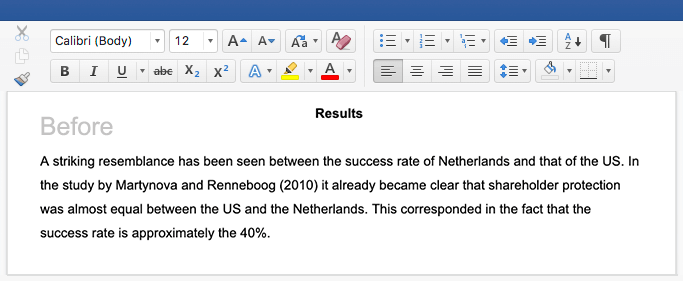
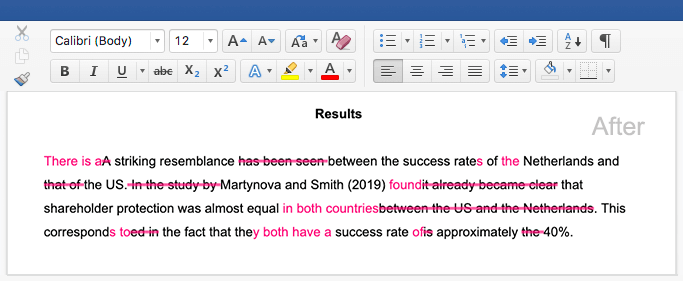
What tin can proofreading do for your paper?
Scribbr editors non only correct grammar and spelling mistakes, but as well strengthen your writing by making sure your paper is costless of vague linguistic communication, redundant words and bad-mannered phrasing.
See editing example
Which descriptive statistics can I apply on my data?
Descriptive statistics help you go an idea of the "middle" and "spread" of your data through measures of fundamental tendency and variability.
When measuring the central trend or variability of your data prepare, your level of measurement decides which methods you tin can use based on the mathematical operations that are appropriate for each level.
The methods you tin can apply are cumulative; at higher levels, y'all tin apply all mathematical operations and measures used at lower levels.
| Data type | Mathematical operations | Measures of central trend | Measures of variability |
|---|---|---|---|
| Nominal |
|
|
|
| Ordinal |
|
|
|
| Interval |
|
|
|
| Ratio |
|
|
|
Quiz: Nominal, ordinal, interval, or ratio?
Frequently asked questions near levels of measurement
- How do I decide which level of measurement to use?
-
Some variables take fixed levels. For example, gender and ethnicity are always nominal level information because they cannot be ranked.
All the same, for other variables, you can choose the level of measurement. For example, income is a variable that can be recorded on an ordinal or a ratio calibration:
- At an ordinal level, you could create 5 income groupings and code the incomes that autumn within them from one–5.
- At a ratio level, you lot would tape exact numbers for income.
If yous have a pick, the ratio level is always preferable because you tin can analyze data in more ways. The higher the level of measurement, the more precise your data is.
Is this article helpful?
You lot have already voted. Thanks :-) Your vote is saved :-) Processing your vote...
manningweenctiny1987.blogspot.com
Source: https://www.scribbr.com/statistics/levels-of-measurement/
0 Response to "Name Each Level of Measurement for Which Data Can Be Qualitative"
Postar um comentário