Live at the Village Vanguard Again
| Alive At The Village Vanguard Again! | ||||
|---|---|---|---|---|
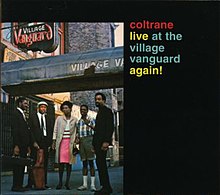 | ||||
| Live anthology by John Coltrane | ||||
| Released | December 1966 | |||
| Recorded | May 28, 1966 | |||
| Venue | Village Vanguard, New York City | |||
| Genre | Costless jazz | |||
| Length | 41:40 | |||
| Characterization | Impulse! (A-9124) | |||
| Producer | Bob Thiele | |||
| John Coltrane chronology | ||||
| ||||
| Review scores | |
|---|---|
| Source | Rating |
| AllMusic |   [1] [1] |
| The Penguin Guide to Jazz | [two] |
| The Rolling Stone Jazz Record Guide | [three] |
Live At The Village Vanguard Again! is a live jazz album past saxophonist John Coltrane. Recorded in May 1966 during a live performance at the Village Vanguard jazz society in New York City, the anthology features Coltrane playing in the free jazz style that characterized his final years. The lineup features Coltrane'south quintet, with Coltrane on tenor and soprano saxophones, bass clarinet, and flute, Pharoah Sanders on tenor saxophone and flute, Alice Coltrane on piano, Jimmy Garrison on bass, and Rashied Ali on drums, supplemented by Emanuel Rahim on percussion.
Coltrane'due south group played at the Village Vanguard on two sequent weekends (May 20–22 and 27-29, 1966), sharing the bill with Clark Terry on the start weekend, and Coleman Hawkins on the second.[4] The album, which was recorded on Sat, May 28, features two extended pieces, "Naima" and "My Favorite Things", culled from a much longer tape.[i] On both the LP and CD releases, the pieces were issued with the bass solo played past Garrison every bit an introduction to "My Favorite Things" divide out as a split up track titled "Introduction to My Favorite Things".[5]
In his liner notes, Nat Hentoff noted: "Both songs accept long been part of the Coltrane repertory, just again Coltrane has found in them the base for new dimensions of expressiveness."[6] Coltrane biographer Eric Nisenson stated that "Coltrane was plainly making a statement about how far he had come since both his first Vanguard album and his first recording of these two pieces. Past recording such familiar tunes, he hoped perhaps to give those having difficulty with his new music some sort of familiar territory from which he could jump off to new, unexplored terrain."[seven] Ekkehard Jost wrote that "a comparison of the different versions of these two titles is all i needs, to realize the influence of the six years in betwixt on Coltrane's musical evolution,"[8] and stated that, on this album, "Naima" "becomes a launching pad for tension-charged improvisations. Points of contact between them and the original material are established in desultory fragments of the theme, and inappreciably at all by harmonic references to the chord progressions. This is a kind of melodic-motivic improvisation that does not take place within the fourth dimension-boundaries of the theme; those boundaries are stretched or shrunk as prompted by the catamenia of musical ideas."[viii]
Reception [edit]
In a review of the concert, Elisabeth van der Mei described the music as "exhilarating," writing: "Rashied Ali has now completely replaced Elvin Jones. Pharaoh Sanders more and more collectively improvises with Coltrane, who himself plays solos for sometimes xxx, 40 minutes having his audience transfixed by the sheer mystery of his force."[four] Gary Giddins stated that the album, "with explosive readings of 'Naima' and 'My Favorite Things,' is an unbridled gift of Coltrane'due south final band at its best: cipher mystical or arcane, no verbal chanting, very little scene setting — just ii strenuously effective post-Ascension performances."[nine]
In a review for AllMusic, Thom Jurek wrote that the album "is certainly not for Coltrane newcomers, and may indeed just hold value for his most agog followers despite its many qualities."[1] Writing for All About Jazz, Robert Spencer praised Pharoah Sanders' solo on "Naima," writing: "his solo here shows in its melodic invention and fervent lyricism that Coltrane wasn't deaf when he asked him to bring together the ring. He knew he would be able to hold up his stop, and he does; too often his work in the late Coltrane quintet is overlooked for its manner, rather than appreciated for its real substance."[10] He concluded: "People talk of 'late Coltrane' as if all of his music after A Honey Supreme sounded the same, simply really the music on this disc is much removed from the likes of Ascension, Om, or Live in Seattle... Not for all tastes, perhaps, merely essential for the musically adventurous."[ten]
Ben Ratliff wrote that the recording of "Naima" "worked with wicked effectiveness," and states: "Sanders's solo on this 'Naima' begins with abrasive huffing and scrambling, non dissimilar from a sound Archie Shepp liked to get; it works through wild passages of fast and repetitive playing, terrifically ugly challenges of squelched and shrieking sounds, and hoarse, lusty tours through sections of the melody. The performance is full of personality, total of its own audio, not at all dull. Sanders uses near purely metamusical logic—intuitive gestures of the emotions, of the nerves—to make the seven-minute solo cohere. With Coltrane, on the other hand, who plays two shorter, more than driving and traditionally dramatic solos effectually Sanders, yous ever seem to be keeping your eye on the resolution most to come. All that he plays exists in relation to the harmony and melody of the song."[xi]
Track listing [edit]
- "Naima" (Coltrane) – 15:10
- "Introduction to My Favorite Things" (Garrison) – vi:09
- "My Favorite Things" (Rodgers, Hammerstein) – twenty:21
Personnel [edit]
- John Coltrane – soprano saxophone, tenor saxophone, bass clarinet, flute
- Pharoah Sanders – tenor saxophone, flute
- Alice Coltrane – piano
- Jimmy Garrison – bass
- Rashied Ali – drums
- Emanuel Rahim – percussion
References [edit]
- ^ a b c Jurek, Thom. "John Coltrane Quintet: Live at the Village Vanguard Once again!". AllMusic . Retrieved October 7, 2020.
- ^ Melt, Richard; Morton, Brian (2008). The Penguin Guide to Jazz Recordings (9th ed.). Penguin. p. 292. ISBN978-0-141-03401-0.
- ^ Swenson, J., ed. (1985). The Rolling Rock Jazz Tape Guide. United states of america: Random Business firm/Rolling Stone. p. 47. ISBN0-394-72643-X.
- ^ a b Porter, Lewis; DeVito, Chris; Fujioka, Yasuhiro; Wild, David; Schmaler, Wolf (2008). The John Coltrane Reference. Routledge. p. 346.
- ^ Porter, Lewis; DeVito, Chris; Fujioka, Yasuhiro; Wild, David; Schmaler, Wolf (2008). The John Coltrane Reference. Routledge. p. 752.
- ^ Hentoff, Nat (1966). Live at the Village Vanguard Again! (liner notes). John Coltrane. Impulse! Records. A-9124.
- ^ Nisenson, Eric (1995). Ascension: John Coltrane And His Quest. Da Capo Press. p. 207.
- ^ a b Jost, Ekkehard (1994). Free Jazz. Da Capo. p. 101.
- ^ Giddins, Gary (1998). Visions of Jazz: The First Century. Oxford University Press. p. 489.
- ^ a b Spencer, Robert (July 1, 1997). "John Coltrane: Live at the Village Vanguard Again!". All Almost Jazz . Retrieved October vii, 2020.
- ^ Ratliff, Ben (2007). Coltrane: The Story of a Audio. Farrar, Straus and Giroux. pp. 107–108.
manningweenctiny1987.blogspot.com
Source: https://en.wikipedia.org/wiki/Live_at_the_Village_Vanguard_Again!
0 Response to "Live at the Village Vanguard Again"
Postar um comentário